Jump to:
Writing a heartfelt birthday message can feel surprisingly challenging. You want to express genuine emotion without sounding generic, be personal without being overly sentimental, and create something memorable without overthinking it. Whether you’re writing for a parent, partner, friend, or child, the right approach can transform a simple birthday greeting into a treasured keepsake.
This comprehensive guide walks you through every step of crafting birthday messages that truly resonates your feelings. The messages that people will save, reread, and remember long after the candles are blown out.
What Makes a Birthday Message Heartfelt?
A heartfelt birthday message goes beyond “Happy Birthday” and generic well-wishes. It’s characterized by:
The difference between a generic message and a heartfelt one is simple: generic messages could apply to anyone, while heartfelt messages could only come from you to this specific person.
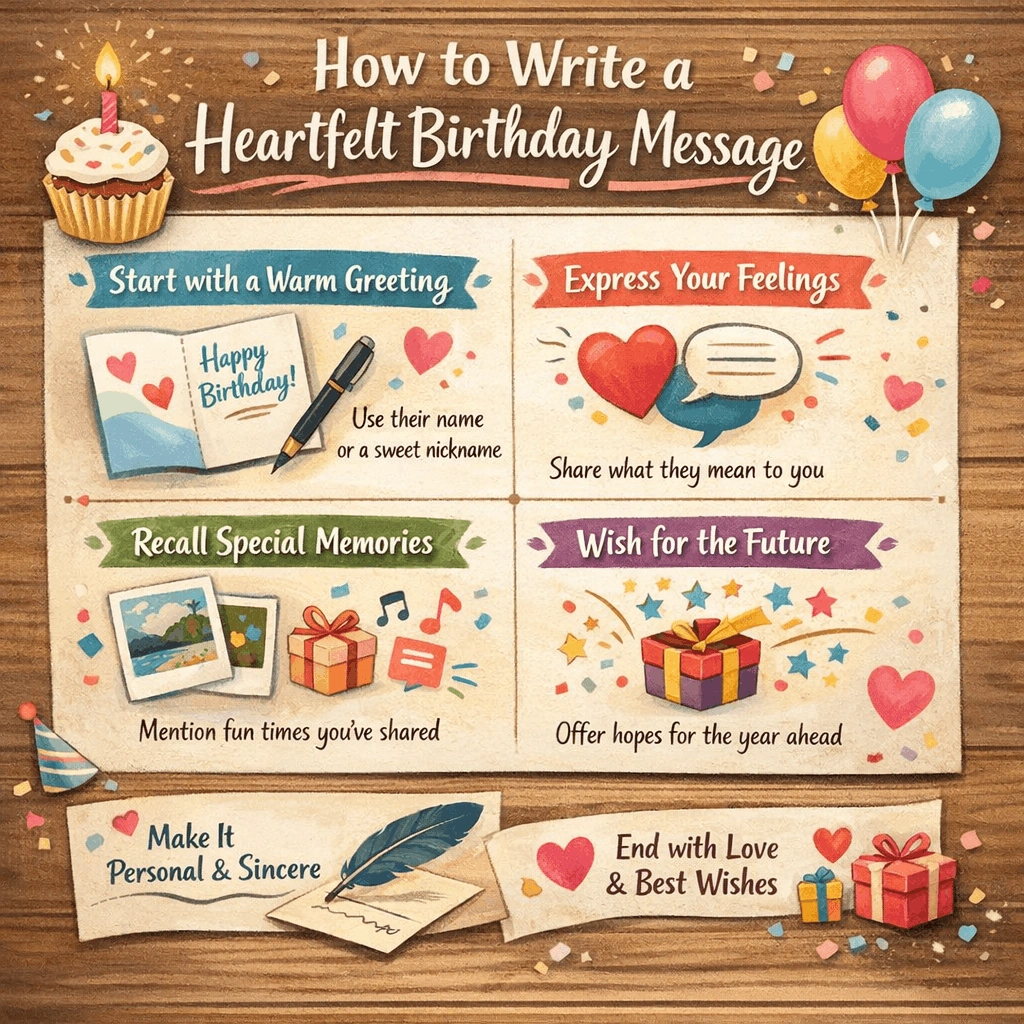
Step 1: Understand Who You’re Writing For
Before putting pen to paper, consider the recipient and your relationship with them.
Consider Their Personality
Are they sentimental or practical? Emotional types appreciate deep feelings expressed fully, while pragmatic people may prefer shorter, sincere messages without excessive emotion.
Do they value humor or seriousness? Some people love lighthearted birthday wishes while others prefer meaningful, thoughtful sentiments.
Are they private or public? This affects whether your message should be kept intimate or could be shared publicly on social media.
What’s their communication style? Match their energy. If they’re casual and relaxed, be conversational; if they’re formal, maintain appropriate dignity.
Assess Your Relationship
How close are you? Deep relationships allow for vulnerability and emotion; newer friendships might require more measured approaches.
What role do you play in their life? Parent, partner, friend, colleague, mentor, etc. Becaue each relationship has different dynamics and appropriate boundaries.
What shared experiences define your bond? These become the foundation for personal references that make messages meaningful.
What’s your communication pattern? If you’re not usually effusive, suddenly being overly emotional might feel inauthentic.
Step 2: Reflect Before You Write
The most heartfelt messages come from genuine reflection, not rushed thinking.
Ask Yourself Key Questions
What do I appreciate most about this person? Think beyond surface traits to character qualities that make them special.
How has this person impacted my life? Consider specific ways they have influenced, supported, or changed you.
What memories stand out from the past year? Recent shared experiences create relevant, timely connections.
What makes our relationship unique? Identify what distinguishes your bond from their other relationships.
What do I hope for them in the coming year? Your wishes for their future add forward-looking warmth.
Gather Mental Material
Before writing, spend a few minutes recalling:
- Specific moments you’ve shared recently
- Qualities you genuinely admire in them
- Times they’ve helped, supported, or inspired you
- Inside jokes or shared references
- Challenges they’re facing or goals they’re pursuing
- Things you’ve learned from them
This reflection phase is crucial because you can’t just write from the heart without first accessing those feelings.
Step 3: Choose Your Tone and Structure
The right tone makes your message feel authentic and appropriate.
Tone Options
Emotional and Vulnerable: “You’ve changed my life in ways I struggle to articulate. Your friendship has been the steady force through my most uncertain times.”
Warm and Appreciative: “I’m so grateful to have you in my life. Your kindness, humor, and loyalty make every day better.”
Lighthearted and Affectionate: “Happy birthday to someone who makes life infinitely more fun! Here’s to another year of adventures and laughter together.”
Sincere and Simple: “Wishing you the happiest birthday. You mean more to me than you probably realize.”
Inspirational and Encouraging: “Happy birthday! This year is going to be incredible for you, I can feel it. You’re ready for everything ahead.”
Message Structure Options
The Three-Part Structure (Most Common):
- Birthday greeting and opening emotion
- Specific appreciation or memory
- Future-focused wishes or closing sentiment
The Storytelling Approach:
- Brief story or memory that illustrates your bond
- What that story reveals about them or your relationship
- Birthday wishes building on that foundation
The List Format:
- “On your birthday, I want you to know…”
- Several specific things you appreciate or admire
- Closing birthday wish
The Letter Format:
- Longer, more detailed exploration of feelings
- Multiple memories or appreciations
- Meaningful closing that feels like a conversation
Choose the structure that feels most natural to how you communicate and the depth you want to convey.
Step 4: Start with a Strong Opening
Your opening sets the emotional tone and captures attention.
Powerful Opening Approaches
Lead with Emotion:
- “My heart is full thinking about your birthday today…”
- “I’m overwhelmed with gratitude that you’re in my life…”
- “There aren’t adequate words for what you mean to me, but on your birthday, I want to try…”
Start with Appreciation:
- “Happy birthday to the person who…”
- “On your special day, I’m reflecting on how much you’ve enriched my life…”
- “Celebrating you today feels important because…”
Begin with Memory:
- “I was just thinking about the time we…”
- “Remember when you…”
- “My favorite memory with you is…”
Use Direct Address:
- “Dear [Name], happy birthday to someone who…”
- “[Name], on your birthday, I want you to truly understand…”
- “To the most [quality] person I know…”
Avoid Weak Openings:
- Generic “Happy Birthday” alone without context
- Apologetic preambles like “I’m not good with words but…”
- Clichéd phrases like “Another year older, another year wiser”
- Impersonal starts that could apply to anyone
Step 5: Add Specific, Personal Details
Specificity transforms generic sentiments into memorable messages.
How to Be Specific
Instead of: “You’re a great friend.” Try: “The way you showed up for me during my job loss, calling daily, sending encouragement, believing in me when I couldn’t has showed me what true friendship looks like.”
Instead of: “I love you so much.” Try: “I love how you make me laugh when I’m stressed, how you remember the small things I mention in passing, and how you challenge me to be better while accepting me exactly as I am.”
Instead of: “Hope you have a great year!” Try: “I hope this year brings you the success you have been working toward, more time to spend with your loved ones, and moments of peace amidst the chaos.”
Types of Specific Details to Include
Recent Moments: “Last month when you stayed late to help me finish that project…”
Character Qualities: “Your ability to find humor in difficult situations…”
Impact Statements: “You taught me that asking for help isn’t weakness…”
Shared Experiences: “All those Saturday morning coffee talks…”
Growth Observations: “Watching you overcome your fear of public speaking…”
Future References: “I can’t wait to see your business launch in the spring…”
The more specific you are, the more the recipient feels truly seen and known.
Step 6: Express Genuine Emotion Without Overdoing It
Authenticity matters more than emotional intensity.
Finding the Right Emotional Balance
Be Honest About Your Feelings: Don’t exaggerate or downplay what you genuinely feel.
Use “I” Statements: “I feel grateful…” is more authentic than “Everyone knows you’re amazing…”
Show, Don’t Just Tell: Instead of saying “You mean everything to me,” explain why or how they matter.
Avoid Emotional Inflation: Not every birthday message needs superlatives. “You’re important to me” can be more powerful than “You’re the most incredible person who ever lived.”
Match Your Typical Dynamic: If you’re not usually connected with someone, suddenly being overly emotional might feel awkward for both of you.
Emotional Authenticity Examples
Balanced Emotion: “Happy birthday! Having you as my sister is one of my life’s greatest gifts. You know me better than anyone, you challenge me to grow, and you love me unconditionally. I’m so grateful for you.”
Too Restrained (if you’re actually very close): “Happy birthday. Hope it’s good.”
Too Intense (if you’re not that close): “Happy birthday! My life was meaningless before I met you. You’re the sun around which my entire existence orbits. I would be nothing without you.”
Trust your instincts about what feels appropriate and genuine.
Step 7: Avoid Common Pitfalls and Clichés
Certain phrases and approaches undermine heartfelt messages.
Clichés to Avoid
Generic Phrases:
- “Another year older, another year wiser”
- “Age is just a number”
- “You don’t look a day over [age]”
- “Make a wish!”
- “Have a great one!”
Overused Sentiments:
- “You deserve the world”
- “You’re one in a million”
- “Friends like you are rare”
- “Hope all your dreams come true”
Why These Fall Flat: They’re so common they’ve lost meaning. The recipient has heard them countless times from countless people.
Pitfalls to Avoid
Making It About You: The birthday message should celebrate them, not recount your own stories without connection to them.
Being Overly Negative: Acknowledging challenges is fine, but don’t make their birthday message focus on problems.
Forced Humor: If a joke doesn’t land naturally, it creates awkwardness rather than joy.
Excessive Length: Heartfelt doesn’t mean endless. Respect their time while being thorough.
Comparing to Others: “You’re better than [person]” or “Not like other [friends/partners/etc.]” feels competitive rather than appreciative.
Backhanded Compliments: “Happy birthday! You’ve really improved since last year” isn’t the compliment you think it is.
Step 8: Close with Meaningful Wishes or Affirmation
Your closing leaves the lasting impression.
Powerful Closing Approaches
Future-Focused Wishes: “May this year bring you joy, growth, and the realization of dreams you’ve been working toward.”
Affirmation of Your Bond: “Grateful every day that you’re in my life. Here’s to many more birthdays celebrated together.”
Specific Hopes for Them: “I hope this year brings you the peace you’ve been seeking and adventures that surprise you.”
Call Back to Opening: If you started with a memory or theme, reference it again for cohesion.
Simple Love Statement: “Love you more than words can express. Happy birthday.”
Encouragement and Belief: “This is going to be your year, I can feel it. You’re ready for everything ahead.”
Closing Signatures
Choose a signature that matches your relationship and message tone:
- “With all my love,” (romantic or very close family)
- “Love always,” (family, close friends)
- “With gratitude,” (mentors, people who’ve helped you)
- “Cheers to you,” (friends, casual relationships)
- “Warmly,” (professional or acquaintance)
- “Forever your [daughter/friend/etc.],” (family or very close bonds)
Step 9: Review and Refine Your Message
Before sending, take time to review and improve.
Editing Checklist
Read It Aloud: Does it sound like something you’d actually say? Does it flow naturally?
Check for Specificity: Have you included details unique to this person and your relationship?
Verify Tone Consistency: Does the tone match throughout, or do you shift awkwardly?
Remove Filler Words: Cut “very,” “really,” “just,” and other words that don’t add meaning.
Eliminate Repetition: Have you said the same thing multiple ways? Choose the strongest expression.
Check Length: Is it appropriate for the relationship and medium? Texts should be shorter than letters.
Proofread: Fix any spelling or grammar errors that might distract from your message.
Assess Authenticity: Does this genuinely sound like you? Would the recipient recognize your voice?
Step 10: Consider Your Delivery Method
How you deliver your message affects its impact.
Delivery Methods and Their Impact
Handwritten Card: Most personal and permanent; recipient can keep and reread it; shows extra effort and thoughtfulness.
Text Message: Immediate and casual; good for relationships where this is your normal communication; can include photos or emojis.
Email: Allows for longer messages; good for distance or professional relationships; easier to craft and edit.
Social Media Post: Public celebration; shows others you care; appropriate for some relationships but invasive for private people.
Video Message: Adds your voice and face; very personal; great for long-distance or when you can’t be there.
In-Person: Most intimate; allows for conversation and physical connection; timing and privacy matter.
Phone Call: Personal and immediate; good when distance prevents in-person but you want more than text.
Greeting Card with Personal Note: Combines visual appeal of a card with personal touch of your handwriting.
Matching Method to Message
Long, emotional messages: Handwritten letter, email, or in-person conversation
Short, sweet sentiments: Text, card, or social media
Humorous messages: Text, card, or in-person where tone is clear
Professional relationships: Card or email, typically not social media
Intimate relationships: Handwritten note, in-person, or personal video
Long-distance: Video message, handwritten letter that arrives on time, or heartfelt email
Examples: Generic vs. Heartfelt Messages
Seeing the difference helps you write better messages.
Example 1: For a Parent
Generic: “Happy Birthday, Mom! Hope you have a great day. You’re the best. Love you!”
Heartfelt: “Happy birthday, Mom! I was thinking this morning about how you always made my childhood magical, the way you turned ordinary moments into adventures and somehow made me feel like the most important person in the world. I hope I can give my own kids even a fraction of that magic someday. Thank you for showing me what unconditional love looks like. Celebrating you today and always.”
Example 2: For a Partner
Generic: “Happy birthday to my amazing partner! You’re the best thing that ever happened to me. Love you so much!”
Heartfelt: “Happy birthday, love! This year you’ve taught me that partnership isn’t about perfection, it’s about showing up for each other consistently, especially when it’s hard. I love how you make me laugh when I’m spiraling, how you believe in my dreams even when they seem impossible, and how you’ve built a life with me that feels both adventurous and safe. Here’s to another year of growing together.”
Example 3: For a Friend
Generic: “Happy birthday! You’re such a great friend. Hope this year is awesome!”
Heartfelt: “Happy birthday! I was just thinking about our 2am conversation last month when I was going through that rough patch. You didn’t try to fix it or give advice, you just listened and made me feel less alone. That’s what you do, you show up with exactly what people need. I’m so lucky our paths crossed. Here’s to another year of spontaneous adventures and conversations that somehow solve everything.”
Read More: Heartfelt Birthday Wishes for Friend
Example 4: For a Colleague
Generic: “Happy birthday! Hope you have a great day!”
Heartfelt: “Happy birthday! I wanted to let you know that working with you has made this job so much better. Your calm approach to chaos and your willingness to help without being asked have taught me a lot about professionalism and kindness. Hope your day is as wonderful as the environment you create for the rest of us.”
Read More: Heartfelt Birthday Wishes for Coworker
Example 5: For a Child
Generic: “Happy birthday, sweetie! You’re growing up so fast. Love you!”
Heartfelt: “Happy birthday to my incredible kid! Watching you this year discover your love for science, stand up for your friend on the playground, and work so hard to master skateboarding has filled my heart with pride. You’re becoming such a kind, curious, brave person. I can’t wait to see what amazing things this year brings you. Love you to the moon and back.”
Special Considerations for Different Relationships
Different relationships require different approaches.
For Romantic Partners
Include: Specific ways they’ve enriched your life, appreciation for qualities others might not see, intimate moments or memories, future hopes together
Avoid: Comparing to exes, focusing only on physical attributes, generic “you complete me” phrases, making it entirely about you
For Parents
Include: Gratitude for sacrifices made, specific lessons they taught you, acknowledgment of their impact on who you’ve become, recognition of their continued role in your life
Avoid: Guilt-inducing messages, dwelling on past conflicts, expectations disguised as birthday wishes, comparing them to other parents
For Children
Include: Pride in who they’re becoming, specific recent achievements or growth, encouragement for their future, unconditional love statements
Avoid: Criticisms or corrections, comparisons to siblings, conditional love based on behavior, pressure disguised as wishes
For Friends
Include: Shared memories, specific ways they’ve supported you, appreciation for their unique qualities, excitement about future experiences together
Avoid: Inside jokes no one else would understand if it’s public, embarrassing stories, guilt about time apart, one-sided recounting
For Professional Relationships
Include: Appreciation for their professionalism, specific ways they’ve helped your work or career, respect for their skills or character
Avoid: Overly personal information, romantic undertones, complaints about work, assumptions about their personal life
Tips for When You’re Struggling to Write
Sometimes the words won’t come, even with good intentions.
Break Through Writer’s Block
Start with One Memory: Pick a single specific moment with them and describe it. The rest often flows from there.
Write Terribly First: Give yourself permission to write badly. You can edit, but you can’t edit a blank page.
Talk It Out: Tell someone else what you appreciate about the birthday person. Then write down what you just said.
Use Prompts: “What I love most about you is…” “My favorite memory with you is…” “You’ve taught me that…”
Set a Timer: Write for 5 minutes without stopping or editing. See what emerges.
Remember Why It Matters: This person’s birthday is an opportunity to express something meaningful. That’s worth the effort.
Keep It Simple: If elaborate won’t come, simple and sincere is always enough.
When Time Is Short
The One-Sentence Formula: “[Name], happy birthday to someone who [specific quality/action]. I’m so grateful for [specific thing]. Here’s to [future wish].”
Example: “Sarah, happy birthday to someone who always knows exactly what to say when I’m struggling. I’m so grateful for your wisdom and friendship. Here’s to a year filled with the adventures you’ve been dreaming about.”
Cultural and Age Considerations
Different contexts require different approaches.
Age-Appropriate Messages
For Children: Keep language simple, focus on fun and growth, be encouraging and affirming.
For Teens: Respect their growing maturity, acknowledge challenges they face, be authentic not condescending.
For Adults: Match their life stage, acknowledge accomplishments and challenges, be peer-to-peer.
For Elderly: Honor their wisdom and experience, acknowledge their impact and legacy, express gratitude.
Cultural Sensitivity
Research Traditions: Some cultures view aging differently. What’s appropriate humor in one may be offensive in another.
Respect Privacy Norms: Public vs. private celebration preferences vary by culture.
Consider Language: If they speak another language primarily, consider writing in that language or acknowledging it.
Be Aware of Milestones: Different cultures emphasize different birthday ages.
Final Checklist: Is Your Message Truly Heartfelt?
Before sending, verify your message meets these criteria:
✓ Could only come from you: Contains details specific to your relationship
✓ Sounds like you: Written in your natural voice and communication style
✓ Focuses on them: Celebrates the birthday person, not just your feelings
✓ Includes specifics: Names particular qualities, moments, or impacts
✓ Feels genuine: Expresses what you truly feel, not what sounds good
✓ Appropriate tone: Matches your relationship and their personality
✓ Right length: Sufficient to be meaningful, concise enough to be readable
✓ Well-crafted: Free of errors, flows smoothly, makes sense
✓ Forward-looking: Includes wishes or hopes for their future
✓ Makes them feel valued: Would make them feel seen, appreciated, loved
If you can check most of these boxes, you’ve written a heartfelt birthday message.
Conclusion!
Writing a heartfelt birthday message requires thought, reflection, and authenticity but the effort creates something far more valuable than a generic greeting. Your words become a gift the recipient can revisit whenever they need a reminder that they matter, that they’re loved, that someone truly sees them.
The formula is ultimately simple: Reflect on who they are, recall what they mean to you, and express it in your own voice with specific details. Everything else is refinement.